Filmography

(Sapna.World Pictures with Attar Films 2011)
70 mins.
Available from:
Academic Video Store (Alexander Street Press)
"Hidden Apartheid: A Report on Caste Discrimination" is an independent human rights documentary that gives an in-depth history and analysis of caste based discrimination. Since the early 1900's, many Indians have left India, seeking freedom from caste based inequality. Caste prejudices have emerged throughout the western diaspora with Indian immigration. Over the last decade a hierarchical atttitude of graded inequality is increasingly evident. Caste discrimination outside India has been reported in community centers, places of worship, work places, educational and political institutions, restaurants, public transportation, and in matrimonial columns.

Written and produced by Mandrika Rupa
Beta SP, 2002
(Maori with English subtitles)
Maori People of New Zealand give an account, in their classical language, of a time when a group of Indian men came and settled in their tribal area in the early 1900’s, and how their families became woven together, up to the present generation. Premiere and 7 day ‘season’ screenings at the Capitol Cinema, Auckland, 2003.

Written and directed by Mandrika Rupa
35mm, 2000.
Narrative Drama. 12 mins.
An Indian diasporic look at what it is to live in colonial New Zealand, in 1942 wartime, when ANZUS soldiers from the United States were stationed there. A coming of age story of an Indian girl who realizes why her family prefer the prejudices of a ‘free’ country to the caste injustices of what they left behind. Festivals include San Francisco International Asian American Film Festival, 3rd I Film Festival, San Francisco, Chicago, and New York. Permanent collection at MoMA, New York. 2006-2008 at Pasifika Styles, Cambridge University, UK exhibition.

Written and directed by Mandrika Rupa
16mm blown up to 35mm, 1996
Narrative Drama. 10 mins.
Narrative drama about a working class girl’s silent and sweet rebellion against cultural expectations, resulting in cross gender antics. The film has played to over 25 festivals in Europe and the United States. Awards in Italy and Paris. Roy and Niuta Titus 2 Theatre, MoMA.

Poonam
SVHS, 1994. Documentary. 16 mins.
A documentary portraying three Indian women whose families came to New Zealand as early as the 1890’s. As they carve out their identities a hybridity emerges. Festivals in Europe and Australia. Distributed by MoMA (New York).

Inheritance : A Lament
Visual Document. DVD 4 Volumes:
This piece uses images shot in India of the artist’s extended family and clan. The family has a history in the West, with NZ Maori (indigenous) and NZ Europeans, for over 100 years. The descendents of this clan, most of whom were born in New Zealand, return to their Gujerat village for the purpose of exploring their indigenous ancestry. From a diverse, cultural mix this Indian-New Zealand artist’s images are blended with Gujarati narration, Punjabi stanzas, and Maori voice, as well as English text. The film depicts clans that were left behind in India when the artist’s forebears emigrated to the new land.
Volume 1 in Maori with English subtitles:
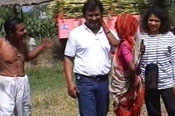
Depicts when the family emigrated to NZ and were welcomed by Maori. Also includes original Punjabi song to depict other Indians who came to NZ at same time.
Volume 2 in Gujarati with English subtitles:
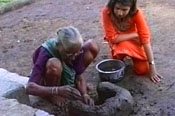
Original poetry in artist's first language. Punjabi stanzas bring out the lament.
Volume 3 in Punjabi with English subtitles:
Punjabi lament for the Indian clans. Pays homage to their leader, Dr. Ambedkar, for helping them gain freedom to emigrate.
Volume 4:
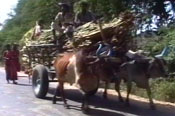
An holistic piece to bring all the earlier volumes together. A fusion of Maori, Gujarati, and Punjabi languages, with English subtitles.
Black Thread Series UK
Visual Document. DVD 6 Volumes
Complete 6 Volume set: 180 mins.
Sold separately each volume: 30 mins.
Oral testaments from the UK of those whose ancestors in India were made to wear the Black Thread. This work illuminates present day struggles in the UK of the lineage described by Mahatma Phule and Babasaheb Ambedkar.
Mr. Virdee
"Baba Saheb introduced in the 1930's a separate electorate for our people at the Round Table...but because of Gandhi, who went on a "fast til his death", the Pune Pact was introduced, which was a stabbing in the back for our people."
Ken
"The Dalits/Untouchables are a group of humanity that have been historically denied their standard rights. They are people who do the dirty work. Because I don't fall into the four varnas (job categories), I'm by definition an 'untouchable'. All foreigners are 'untouchables'."
Satpal
"I refer to Dalits as 'untouchables' because 'untouchables' is more expressive and explains the plight of Dalits ... anyone who has studied the history and condition of how Dalit people have lived for thousands of years knows that the relationship between caste Hindus and 'untouchables' is one of master and slave."
Mr Nahar
"We are under the Chaturvarna - Dalits of the Dalit- we have been slaves for a long time and we are the native people of India...of 156 million 'untouchables' in India, only 1% are educated...Valmiki 'churra' are the manual scavengers, they clear toilets, rubbish, dead animals..."
Savio
"I'm in UK, how am I able to be here and talk for my own people, Dalits, 'untouchable' people? Is because I'm educated, not because of a Hindu system but because of Christianity which came to India at the time...The Christian Missionaries started schools, they went door to door, took the 'untouchables', took them to school, and gave them an education."
Mr. Patil
"The Manusmriti is a notorious book which was written a long time ago and still today its rules are implemented religiously. In every sense the Manusmriti is a discriminating document against women, against 'untouchables', against other castes, it only privileges the Brahmins."
Against Her Will
Script in development
This film will examine the practices and consequences of arranged/enforced marriage and dowry abuse in the western world.
To order the above films
Please contact Sapna World:
sapnaworld56@gmail.com
PO Box 46-183, Herne Bay, Auckland, New Zealand.